
Innovation and Technology
AMD Unveils MI350 GPU And Roadmap

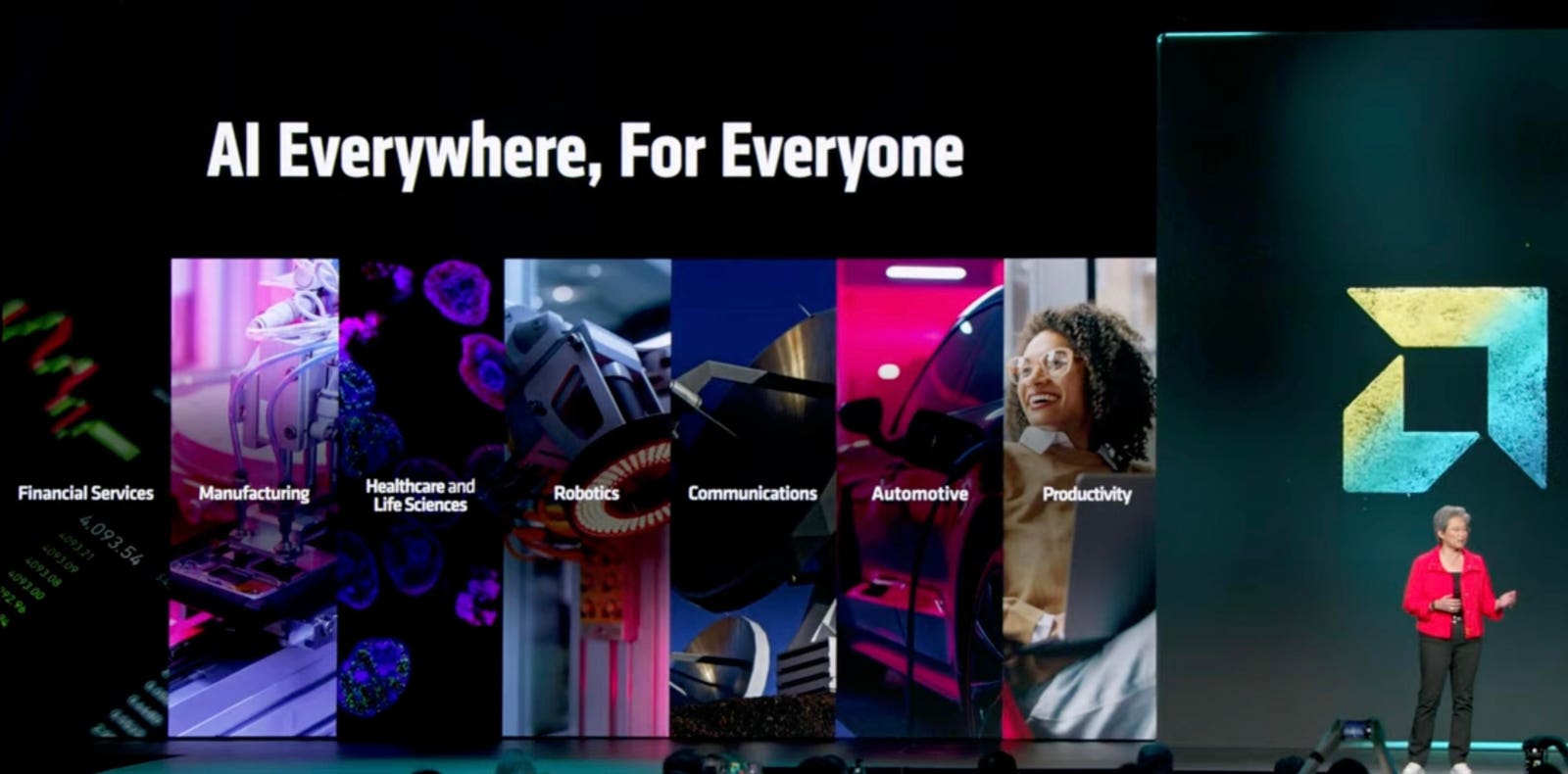
Introduction to AMD’s Advancing AI Event
AMD held their now-annual Advancing AI event today in Silicon Valley, with new GPUs, new networking, new software, and even a rack-scale architecture for 2026/27 to better compete with the Nvidia NVL72 that is taking the AI world by storm. The event was kicked off by Dr. Lisa Su, Chairman and CEO of AMD.
Net-Net Conclusions: AMD Is Catching Up
While AMD has yet to achieve investor expectations, and its products remain a distant second to Nvidia, AMD continues to keep to its commitment to an annual accelerator roadmap, delivering nearly four times better performance gen-on-gen with the MI350. That pace could help it catch up to Nvidia on GPU performance, and keeps it ahead of Nvidia regarding memory capacity and bandwidth, although Nvidia’s lead in networking, system design, AI software, and ecosystem remains intact.
However, AMD has stepped up its networking game with support for UltraEthernet this year and UALink next year for scale-out and scale-up, respectively. And, for the first time, AMD showed a 2026/27 roadmap with the “Helios” rack-scale AI system that helps somewhat versus Nvidia NVL72 and the upcoming Kyber rack-scale system. At least AMD is now on the playing field.
Oracle said they are standing up a 27,000 GPU cluster using AMD Instinct GPUs on Oracle Cloud Compute Infrastructure, so AMD is definitely gaining traction. AMD also unveiled ROCm 7.0 and the AMD Developer Cloud Access Program, helping it build a larger and stronger AI ecosystem.
The AMD MI350Series GPUs
The AMD Instinct GPU portfolio has struggled to catch up with Nvidia, but customers value the price/performance and openness of AMD. In fact, AMD claims to offer 40% more tokens per dollar, and that 7 of the 10 largest AI companies have adopted AMD GPUs, among over 60 named customers.
The biggest claim to fame AMD touts is the larger memory footprint it supports, now at 288 GB of HBM3 memory with the MI350. That’s enough memory to hold today’s larger models, up to 520B parameters, on a single node, and 60% more than the competition. That translates to lower TCO for many models. The MI350 also has twice the 64-bit floating point performance versus Nvidia, important for HPC workloads.
The MI355 is the same silicon as the MI300 but is selected to run faster and hotter, and is AMD’s flagship data center GPU. Both GPUs are available on the UBB8 industry standard boards in both air- and liquid cooled versions.
AMD claims, and has finally demonstrated through MLPerf benchmarks, that the MI355 is roughly three times faster than the MI300, and even on par with the Nvidia B200 GPU from Nvidia. But keep in mind that Nvidia NVLink, InfiniBand, system design, ecosystem, and software keep it in a leadership position for AI, while the B300 will begin shipment soon.
AMD’s GPU Roadmap Becomes More Clear
AMD added some detail on next year’s MI400 series as well. Sam Altman himself appeared on stage and gave the MI450 some serious love. His company has been instrumental in laying out the market requirements to the AMD engineering teams.
The MI400 will use HBM4 at 423GB per GPU, as well as supporting 300GB/s UltraEthernet through Pensando NICs.
To put the MI400 performance into perspective, check out the hockey stick performance they are expecting in the graph below. This reminds us of a similar slide Jensen Huang used at GTC. Clearly, AMD is on the right path.
Networking: AMD’s Missing Link
While a lot of attention in the AMD Advancing AI event surrounded the MI350/355 GPUs and the roadmap, the networking section was more exciting and important.
More important to large-scale AI, AMD is an original member of the UALink consortium, and will support UALink with the MI400 series. While the slide below makes it look amazing, keep in mind that Nvidia will likely be shipping NVLink 6.0 in the same timeframe, or earlier.
AMD ROCm Might Actually Start to Rock!
Finally, let’s give ROCm some credit. The development team has been hard at work since the Silicon Analysis crushed the AI software stack late last year, and they have some good performance results to show for it as well as ecosystem adoption.
To demonstrate the performance point, AMD showed over three times the performance for inference processing using ROCm 7. This is in part due to the ever-improving state of the open AI stack such as Triton from OpenAI, and is a developing trend that will keep Nvidia on its toes.
Conclusion
In conclusion, AMD’s Advancing AI event showed that the company is committed to catching up with Nvidia in the AI space. With its new GPUs, improved networking, and enhanced software, AMD is making significant strides in the industry. While Nvidia still maintains a leadership position, AMD’s efforts are helping to close the gap.
FAQs
Q: What was the main focus of AMD’s Advancing AI event?
A: The main focus of AMD’s Advancing AI event was to showcase the company’s new GPUs, improved networking, and enhanced software, as well as its commitment to catching up with Nvidia in the AI space.
Q: What is the MI350 and how does it compare to Nvidia’s GPUs?
A: The MI350 is AMD’s new GPU that offers 288 GB of HBM3 memory and twice the 64-bit floating point performance versus Nvidia. While it still lags behind Nvidia’s GPUs in some areas, it provides a competitive alternative with its larger memory footprint and lower TCO.
Q: What is AMD’s GPU roadmap for the future?
A: AMD’s GPU roadmap includes the MI400 series, which will use HBM4 at 423GB per GPU and support 300GB/s UltraEthernet through Pensando NICs. The company is also working on a rack-scale AI system called "Helios" for 2026/27.
Q: How does AMD’s ROCm software stack compare to Nvidia’s?
A: AMD’s ROCm software stack has improved significantly over the last two years and has seen broad ecosystem collaboration. While Nvidia’s software stack is still more comprehensive, AMD’s ROCm is becoming a more viable alternative with its improved performance and openness.




Community Mentorship Programs Help Strengthen Local Workforce and Social Impact

Low-Code Platforms are Changing How Businesses Build Internal Technology

Microlearning in Employee Training: A Practical Approach to Workplace Skill Development

Decision-Making Frameworks Improve Strategic Leadership and Organizational Clarity

Career Ladder Programs Strengthen Workforce Development and Employee Retention

Workplace Recognition Programs Improve Organizational Culture and Employee Engagement

Why Mental Endurance is Essential for Workplace Resilience

What Informational Interviews are and Why they Matter

How Emotional Intelligence Can Help You Manage Stress and Build Resilience

Interview with Dr. Kristy K. Taylor, WORxK Global News Magazine Founder

Sarah Herrlinger Talks AirPods Pro Hearing Aid

NetWork Your Way to Success: Top Tips for Maximizing Your Professional Network

Unlocking Human Potential: Kim Groshek’s Journey to Transforming Leadership and Stress Resilience

The Power of Belonging: Why Feeling Accepted Matters in the Workplace

Health-care stocks fall after Warren PBM bill, Brian Thompson shooting

Glenda Benevides: Creating Global Impact Through Music
-
 Resiliency7 months ago
How Emotional Intelligence Can Help You Manage Stress and Build Resilience
-
 Career Advice1 year ago
Interview with Dr. Kristy K. Taylor, WORxK Global News Magazine Founder
-
 Diversity and Inclusion (DEIA)1 year ago
Sarah Herrlinger Talks AirPods Pro Hearing Aid
-
 Career Advice1 year ago
NetWork Your Way to Success: Top Tips for Maximizing Your Professional Network
-
 Changemaker Interviews1 year ago
Unlocking Human Potential: Kim Groshek’s Journey to Transforming Leadership and Stress Resilience
-
 Diversity and Inclusion (DEIA)1 year ago
The Power of Belonging: Why Feeling Accepted Matters in the Workplace
-
 Global Trends and Politics1 year ago
Health-care stocks fall after Warren PBM bill, Brian Thompson shooting
-
 Changemaker Interviews12 months ago
Glenda Benevides: Creating Global Impact Through Music