
Global Trends and Politics
Carvana Q1 2025 Earnings Report

Introduction to Carvana’s First-Quarter Results
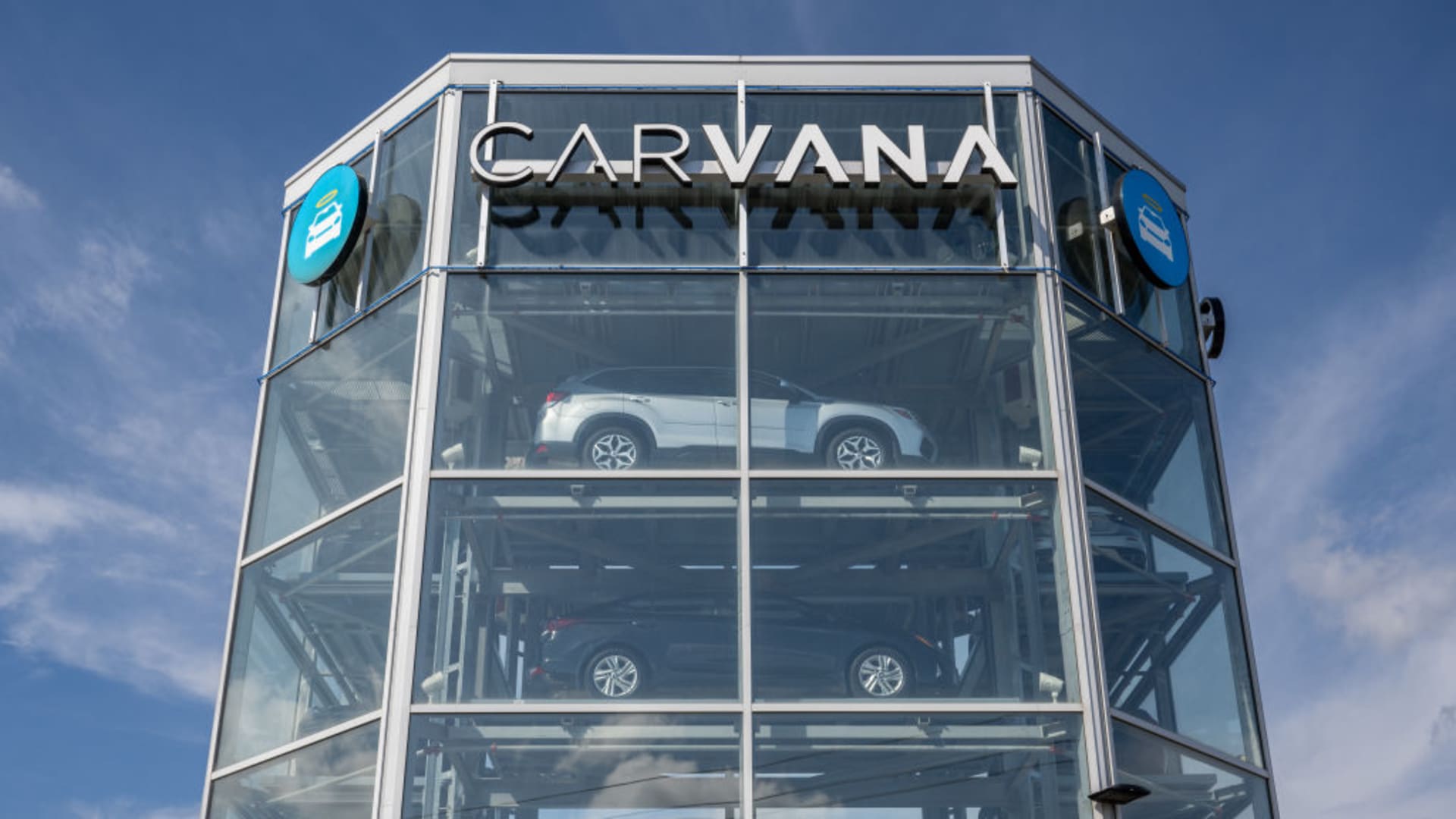
Vehicles are seen on display at a Carvana dealership in Austin, Texas, on Feb. 20, 2023.
Carvana’s first-quarter results easily topped Wall Street’s expectations as the company reported record sales driven by higher-than-expected industry demand amid fears of price increases due to automotive tariffs.
Carvana’s Performance
Carvana CEO and co-founder Ernie Garcia loosely addressed potential impacts of tariffs on the business, saying the company experienced "little gyrations" of demand that have since leveled off. He downplayed the idea that the levies would have any material impact on its business that the company can’t handle.
"I don’t think we have too much interesting there," Garcia said Wednesday during the company’s quarterly call, adding that pricing may increase and could potentially be beneficial for used car sales.
Impact of Tariffs on Used Car Sales
While the tariffs of 25% on new imported vehicles and many parts do not directly impact used car sales, changes in new vehicle prices, production and demand affect the used car market.
A closely watched barometer for used vehicle pricing jumped last month to its highest level since October 2023 as dealers and consumers rushed purchases amid fears of price hikes due to auto tariffs, Cox Automotive reported earlier Wednesday.
Financial Performance
Here’s how the company performed in the first quarter, compared with average estimates:
- Earnings per share: $1.51 vs. 67 cents expected
- Revenue: $4.23 billion vs. $3.98 billion expected
The online used vehicle retailer reported a 46% increase in year-over-year sales during the first three months of the year to nearly 134,000 units. Carvana also reported records of net income of $373 million; adjusted earnings before interest, taxes, depreciation and amortization, or EBITDA, of $488 million; and operating income of $394 million.
Long-Term Objectives and Quarterly Guidance
The company said its net income benefitted from roughly from $158 million associated with positive changes in the fair value of its warrants to acquire common stock of Carvana partner Root auto insurance.
Revenue of $4.23 billion was up 38% year over year from $3.06 billion.
Carvana, which doesn’t typically provide detailed annual targets, on Wednesday also updated its long-term objectives and quarterly guidance.
Its second-quarter guidance includes a "sequential increase in both retail units sold and adjusted EBITDA," while the new "management objective" is to sell 3 million retail units per year at an adjusted EBITDA margin of 13.5% within five to 10 years.
Conclusion
"We are incredibly well positioned for the path ahead and have very clear visibility to even stronger financial performance, much larger scales, and even better customer experiences," Garcia said in a release.
Garcia told investors the goal is "very exciting and very achievable," while noting that the company will prioritize "growth over margin within reasonable margin ranges."
The company’s return to growth comes several years after concerns that Carvana was close to bankruptcy as it focused on growth and mismanaged inventories during the coronavirus pandemic in 2021 to 2022.
Since then, the company has benefitted from a years-long restructuring to lower costs and increase efficiency, including shares of the company increasing roughly 27% this year.
FAQs
Q: What were Carvana’s first-quarter earnings per share?
A: Carvana’s first-quarter earnings per share were $1.51, exceeding the expected 67 cents.
Q: How did Carvana’s revenue perform in the first quarter?
A: Carvana’s revenue was $4.23 billion, up 38% year over year from $3.06 billion.
Q: What is Carvana’s long-term objective?
A: Carvana’s new management objective is to sell 3 million retail units per year at an adjusted EBITDA margin of 13.5% within five to 10 years.
Q: How has Carvana’s stock performed this year?
A: Carvana’s shares have increased roughly 27% this year.


Community Mentorship Programs Help Strengthen Local Workforce and Social Impact

Low-Code Platforms are Changing How Businesses Build Internal Technology

Microlearning in Employee Training: A Practical Approach to Workplace Skill Development

Decision-Making Frameworks Improve Strategic Leadership and Organizational Clarity

Career Ladder Programs Strengthen Workforce Development and Employee Retention

Workplace Recognition Programs Improve Organizational Culture and Employee Engagement

Why Mental Endurance is Essential for Workplace Resilience

What Informational Interviews are and Why they Matter

How Emotional Intelligence Can Help You Manage Stress and Build Resilience

Interview with Dr. Kristy K. Taylor, WORxK Global News Magazine Founder

Sarah Herrlinger Talks AirPods Pro Hearing Aid

NetWork Your Way to Success: Top Tips for Maximizing Your Professional Network

Unlocking Human Potential: Kim Groshek’s Journey to Transforming Leadership and Stress Resilience

The Power of Belonging: Why Feeling Accepted Matters in the Workplace

Health-care stocks fall after Warren PBM bill, Brian Thompson shooting

Glenda Benevides: Creating Global Impact Through Music
-
 Resiliency7 months ago
How Emotional Intelligence Can Help You Manage Stress and Build Resilience
-
 Career Advice1 year ago
Interview with Dr. Kristy K. Taylor, WORxK Global News Magazine Founder
-
 Diversity and Inclusion (DEIA)1 year ago
Sarah Herrlinger Talks AirPods Pro Hearing Aid
-
 Career Advice1 year ago
NetWork Your Way to Success: Top Tips for Maximizing Your Professional Network
-
 Changemaker Interviews1 year ago
Unlocking Human Potential: Kim Groshek’s Journey to Transforming Leadership and Stress Resilience
-
 Diversity and Inclusion (DEIA)1 year ago
The Power of Belonging: Why Feeling Accepted Matters in the Workplace
-
 Global Trends and Politics1 year ago
Health-care stocks fall after Warren PBM bill, Brian Thompson shooting
-
 Changemaker Interviews12 months ago
Glenda Benevides: Creating Global Impact Through Music