
Innovation and Technology
How This MIT Scientist Is Rewiring Robots To Keep The Humanity In Tech

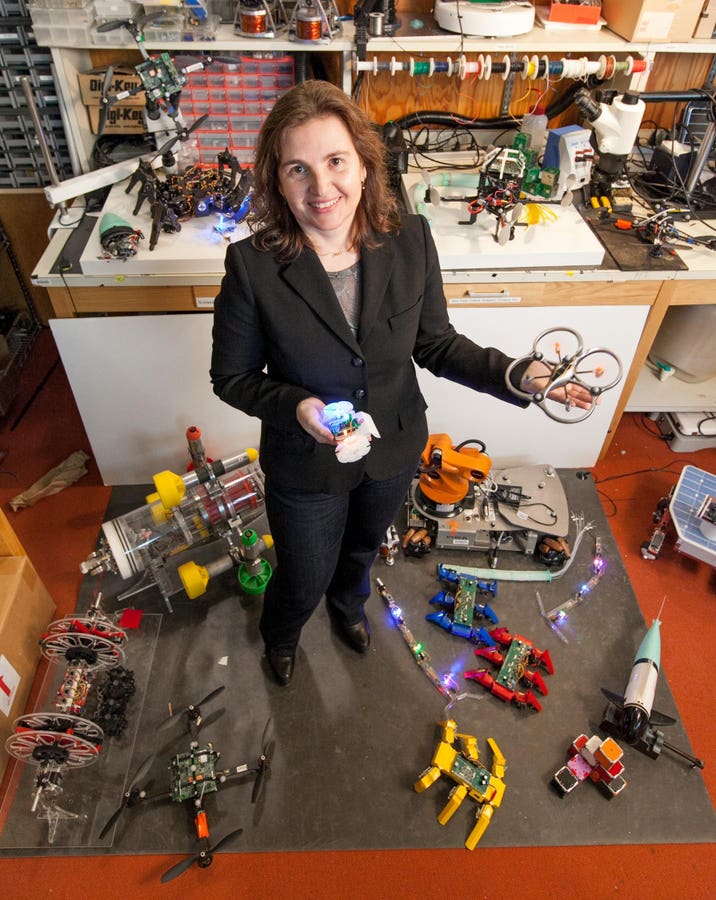
Daniela Rus, a renowned leader in robotics and Director of MIT’s Computer Science and Artificial Intelligence Laboratory (CSAIL), has a mission that goes beyond the realm of technology. Inspired by Carl Sagan’s words, “Look again at that dot. That’s here. That’s home. That’s us,” Rus is driven to create intelligent machines that not only advance humanity but also prioritize responsibility and empathy.
From Humble Beginnings to Pioneering Innovation
Rus was born in Communist Romania under Nicolae Ceaușescu’s regime, where her world was limited, but her imagination was fueled by books like Jules Verne’s Twenty Thousand Leagues Under the Sea and Around the World in Eighty Days. She emigrated to the United States with her family in 1982 and pursued a degree in computer science and mathematics, with a minor in astronomy. Her fascination with space and problem-solving led her to explore how computation interacts with the physical world, ultimately earning her a PhD in the field.
Rus’s journey has always been about using math and computing to understand the mysteries surrounding us. She notes that digital computation is clean, but the physical world is messy, continuous, and uncertain, requiring new models of intelligence. At her lab, the focus is not just on how robots move, but why, and what began with soft robotics and self-driving cars has evolved into a new generation of artificial intelligence that grasps context and consequence.
Introducing Liquid AI: A New Era of Intelligence
Liquid AI, a startup co-founded by Rus, is revolutionizing the boundaries of artificial intelligence. Inspired by the humble worm, which has only 302 neurons yet adapts extraordinarily, the company has developed liquid neural networks that mirror this natural efficiency. With a recent $250 million Series A funding led by AMD, valuing the company at $2 billion, Liquid AI is proving that smaller, smarter systems can compete with the biggest models in the world.
The team’s philosophy is centered around building intelligence that is interpretable, energy-efficient, and capable of making real-time decisions without relying on brute-force computing. Rus emphasizes that progress doesn’t have to mean more; it can mean smarter. By moving computation from distant servers to devices in our hands, homes, and workplaces, Liquid AI empowers people and organizations while reducing cost, latency, and energy use.
Smarter, Not Bigger: The Economics of Private Edge AI
Rus envisions a different trajectory for AI, one defined by capability, adaptability, and energy efficiency. Private edge AI has the potential to redistribute innovation, much like the shift from mainframes to personal computers. By decoupling intelligence from centralized data centers, value is moved from infrastructure providers to everyone else, creating a more equitable and innovative landscape.
Imagine models that run locally on your phone, glasses, or even suitcase. Rus notes that this is not just a technological advancement but a personal revolution, where intelligence is truly everywhere and private. The implications are profound, with the potential to restore autonomy for individuals, such as the visually impaired, and amplify human dignity.
The Most Radical Robot of All: Human Dignity
Rus’s conversation is a delicate balance between cosmic wonder and engineering precision. She emphasizes that technology’s purpose is not dominance but human dignity. With robots, we can amplify strength and precision, and with AI, we can amplify cognition, creativity, empathy, and foresight. These tools should help us become better versions of ourselves.
Rus recounts her experience building a navigation system for Andrea Bocelli, which mapped self-driving technology onto wearables, allowing him to move safely through unfamiliar spaces. She imagines that powered by edge AI, such technology could be even more transformative, amplifying human potential and dignity.
The Intelligence We’re Missing: Women in AI
Rus addresses the gender gap in AI with candor, noting that the barrier starts early, with girls often receiving subtle signals that these paths are not for them. Her solution is to normalize ambition, celebrating girls who aspire to be roboticists, astronauts, or engineers. By expanding the pool of creativity, we change outcomes and statistics, ultimately shaping one of the most important conversations of our time.
Rus encourages her female students to prepare, excel, and take up space unapologetically, shaping the future of AI and beyond. As she reflects on the pale blue dot, Rus emphasizes that awareness comes with responsibility – for each other, our planet, and future generations. For her, AI is not about human redundancy but making humanity more thoughtful, with the rest being just code.




Community Mentorship Programs Help Strengthen Local Workforce and Social Impact

Low-Code Platforms are Changing How Businesses Build Internal Technology

Microlearning in Employee Training: A Practical Approach to Workplace Skill Development

Decision-Making Frameworks Improve Strategic Leadership and Organizational Clarity

Career Ladder Programs Strengthen Workforce Development and Employee Retention

Workplace Recognition Programs Improve Organizational Culture and Employee Engagement

Why Mental Endurance is Essential for Workplace Resilience

What Informational Interviews are and Why they Matter

How Emotional Intelligence Can Help You Manage Stress and Build Resilience

Interview with Dr. Kristy K. Taylor, WORxK Global News Magazine Founder

Sarah Herrlinger Talks AirPods Pro Hearing Aid

NetWork Your Way to Success: Top Tips for Maximizing Your Professional Network

Unlocking Human Potential: Kim Groshek’s Journey to Transforming Leadership and Stress Resilience

The Power of Belonging: Why Feeling Accepted Matters in the Workplace

Health-care stocks fall after Warren PBM bill, Brian Thompson shooting

Glenda Benevides: Creating Global Impact Through Music
-
 Resiliency7 months ago
How Emotional Intelligence Can Help You Manage Stress and Build Resilience
-
 Career Advice1 year ago
Interview with Dr. Kristy K. Taylor, WORxK Global News Magazine Founder
-
 Diversity and Inclusion (DEIA)1 year ago
Sarah Herrlinger Talks AirPods Pro Hearing Aid
-
 Career Advice1 year ago
NetWork Your Way to Success: Top Tips for Maximizing Your Professional Network
-
 Changemaker Interviews1 year ago
Unlocking Human Potential: Kim Groshek’s Journey to Transforming Leadership and Stress Resilience
-
 Diversity and Inclusion (DEIA)1 year ago
The Power of Belonging: Why Feeling Accepted Matters in the Workplace
-
 Global Trends and Politics1 year ago
Health-care stocks fall after Warren PBM bill, Brian Thompson shooting
-
 Changemaker Interviews12 months ago
Glenda Benevides: Creating Global Impact Through Music