
Global Trends and Politics
Tariffs on Mexico and Canada Challenge Auto Industry

Tariffs on Canada, Mexico, and China Expected to Have Profound Impact on Global Automotive Industry
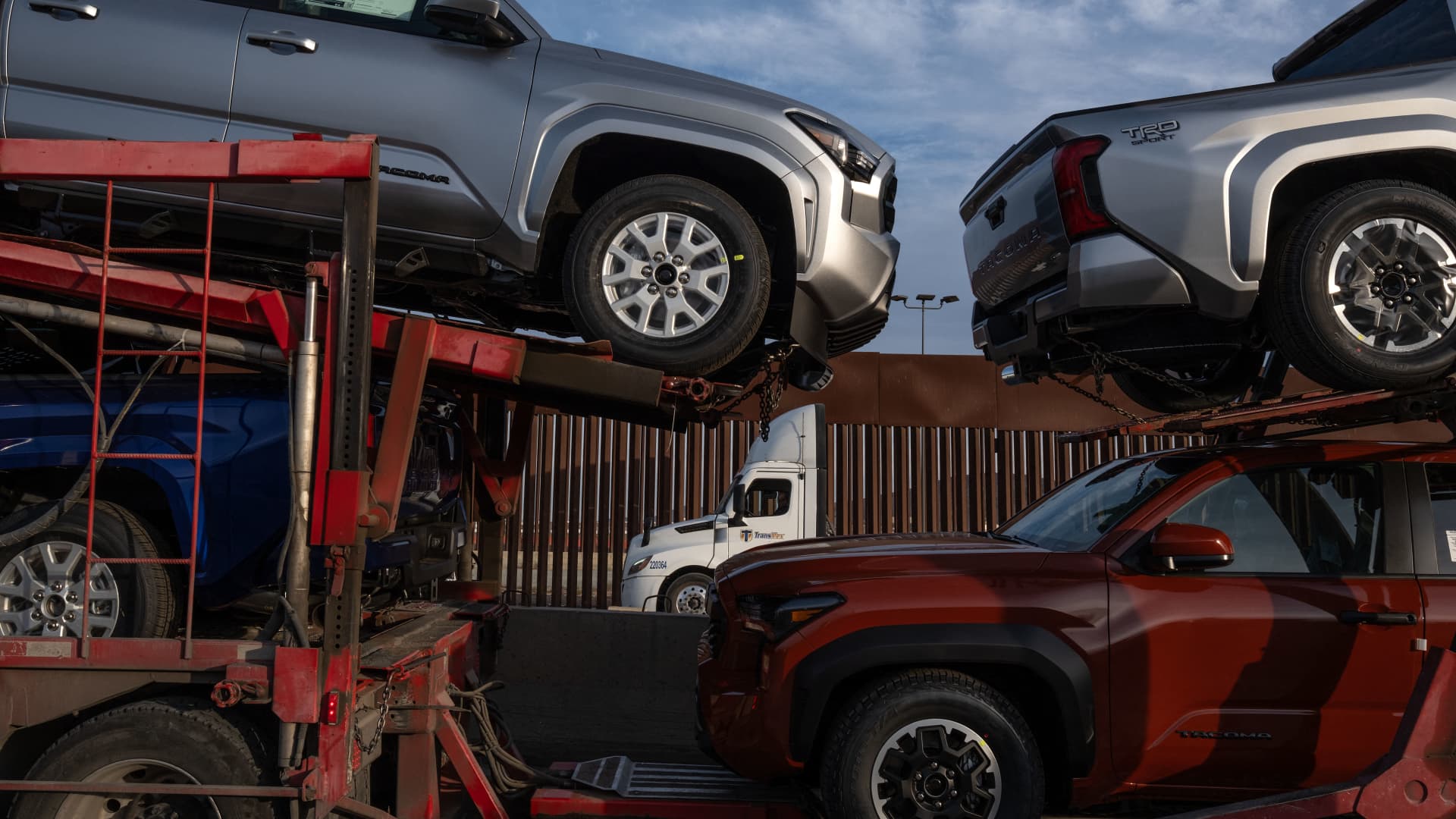
A car carrier trailer waits in line next to the border wall before crossing to the United States at Otay commercial port in Tijuana, Baja California state, Mexico, on Jan. 22, 2025.
Guillermo Arias | AFP | Getty Images
DETROIT — Tariffs announced Saturday by the Trump administration of 25% on goods from Canada and Mexico as well as an additional 10% on products from China are expected to have a profound impact on the global automotive industry.
For months, automakers have been taking a "wait-and-see" approach to the Trump administration’s tariff threat. That waiting period is coming to an end and automakers will likely need to implement prior contingency plans to attempt to offset additional costs in the coming weeks and months.
Impact on the Automotive Industry
Depending on the details, the tariffs on Mexico could have the greatest impact on the automotive industry, followed by Canada and then China, depending on the automaker.
"Any tariff action must be followed with a renegotiation of the [United States-Mexico-Canada Agreement], and a full review of the corporate trade regime that has devastated the American and global working class," Shawn Fain, president of the United Auto Workers Union, said in a statement.
Automaker Reactions
General Motors and other major automakers did not immediately respond for comment regarding the tariffs Saturday night. Others such as Ford declined to comment, while Honda issued a broad statement: "North American auto trade is key to the success of Honda globally and we look forward to a swift resolution that provides clarity and stability throughout the region."
Most major automakers have factories in the U.S. However, they still rely heavily on imports from other countries including Mexico to meet American consumer demand.
Tariffs and the Industry
A tariff is a tax on imports, or foreign goods, brought into the United States. The companies importing the goods pay the tariffs, and some fear the companies would simply pass any additional costs on to consumers — raising the cost of vehicles and potentially reducing demand.
The formal announcement provides some clarity for companies but could cost automakers, many of which have produced vehicles without tariffs in Canada and Mexico for decades, billions of dollars.
Uncertainty and Contingency Plans
Uncertainty about trade took a toll on GM on Tuesday, when the automaker’s stock had one of its worst days in years even after it beat Wall Street’s expectations for its 2025 guidance and its top- and bottom-line for the fourth quarter.
"Our key take from GM’s 4Q [earnings] result is that while the opportunity for GM is highly compelling, US policy uncertainty must be navigated for the time being," Barclays analyst Dan Levy said in an investor note Wednesday.
GM did not account for potential tariffs in its guidance, which CFO Paul Jacobson described as a "cautious" approach given no duties on North American goods had been implemented yet.
Impact on Earnings
Wells Fargo estimates that 25% tariffs on Mexico and Canada imports would cost the traditional Detroit automaker billions of dollars a year. The firm estimates the impact of 5%, 10% and 25% tariffs on GM, Ford Motor, and Chrysler parent Stellantis would collectively be $13 billion, $25 billion and $56 billion, respectively.
S&P Global Mobility, formerly IHS Markit, estimates a 25% duty on a $25,000 vehicle from Canada or Mexico would add $6,250 to its cost — some if not most of which could be passed on to the consumer.
Automakers Most at Risk
S&P Mobility reports plants in Canada and Mexico produce roughly 5.3 million vehicles, with about 70% — nearly 4 million — destined for the U.S.
Mexico accounted for a majority of those vehicles, as five automakers — Ford, GM, Stellantis, Toyota Motor, and Honda — produced only an estimated 1.3 million light-duty vehicles in 2024 in Canada, largely for the U.S. market, according to a Canadian manufacturing nonprofit research group.
Conclusion
The tariffs announced by the Trump administration are expected to have a profound impact on the global automotive industry. Automakers will need to implement prior contingency plans to attempt to offset additional costs in the coming weeks and months. The industry is deeply integrated between the countries, with Mexico importing 49.4% of all auto parts from the U.S. In turn, Mexico exports 86.9% of its auto parts production to the U.S.
FAQs
Q: What are the tariffs announced by the Trump administration?
A: The tariffs are 25% on goods from Canada and Mexico, as well as an additional 10% on products from China.
Q: How will the tariffs impact the automotive industry?
A: The tariffs are expected to have a profound impact on the global automotive industry, with automakers likely to implement prior contingency plans to attempt to offset additional costs.
Q: Which automakers are most at risk from the tariffs?
A: Volkswagen, Nissan, Stellantis, GM, Ford, Honda, Toyota, and Hyundai are the automakers most exposed to tariffs on vehicles imported from Mexico, based on the percentage of their U.S. sales being produced south of the border.
Q: What is the estimated impact of the tariffs on automaker earnings?
A: Wells Fargo estimates that 25% tariffs on Mexico and Canada imports would cost the traditional Detroit automaker billions of dollars a year. The firm estimates the impact of 5%, 10% and 25% tariffs on GM, Ford Motor, and Chrysler parent Stellantis would collectively be $13 billion, $25 billion and $56 billion, respectively.


Community Mentorship Programs Help Strengthen Local Workforce and Social Impact

Low-Code Platforms are Changing How Businesses Build Internal Technology

Microlearning in Employee Training: A Practical Approach to Workplace Skill Development

Decision-Making Frameworks Improve Strategic Leadership and Organizational Clarity

Career Ladder Programs Strengthen Workforce Development and Employee Retention

Workplace Recognition Programs Improve Organizational Culture and Employee Engagement

Why Mental Endurance is Essential for Workplace Resilience

What Informational Interviews are and Why they Matter

How Emotional Intelligence Can Help You Manage Stress and Build Resilience

Interview with Dr. Kristy K. Taylor, WORxK Global News Magazine Founder

Sarah Herrlinger Talks AirPods Pro Hearing Aid

NetWork Your Way to Success: Top Tips for Maximizing Your Professional Network

Unlocking Human Potential: Kim Groshek’s Journey to Transforming Leadership and Stress Resilience

The Power of Belonging: Why Feeling Accepted Matters in the Workplace

Health-care stocks fall after Warren PBM bill, Brian Thompson shooting

Glenda Benevides: Creating Global Impact Through Music
-
 Resiliency7 months ago
How Emotional Intelligence Can Help You Manage Stress and Build Resilience
-
 Career Advice1 year ago
Interview with Dr. Kristy K. Taylor, WORxK Global News Magazine Founder
-
 Diversity and Inclusion (DEIA)1 year ago
Sarah Herrlinger Talks AirPods Pro Hearing Aid
-
 Career Advice1 year ago
NetWork Your Way to Success: Top Tips for Maximizing Your Professional Network
-
 Changemaker Interviews1 year ago
Unlocking Human Potential: Kim Groshek’s Journey to Transforming Leadership and Stress Resilience
-
 Diversity and Inclusion (DEIA)1 year ago
The Power of Belonging: Why Feeling Accepted Matters in the Workplace
-
 Global Trends and Politics1 year ago
Health-care stocks fall after Warren PBM bill, Brian Thompson shooting
-
 Changemaker Interviews12 months ago
Glenda Benevides: Creating Global Impact Through Music