
Global Trends and Politics
Why It’s Getting Harder to Get a Free First-Class Flight Upgrade

From Giveaways to Paying Up: Airlines Shift Priority to Premium Seats
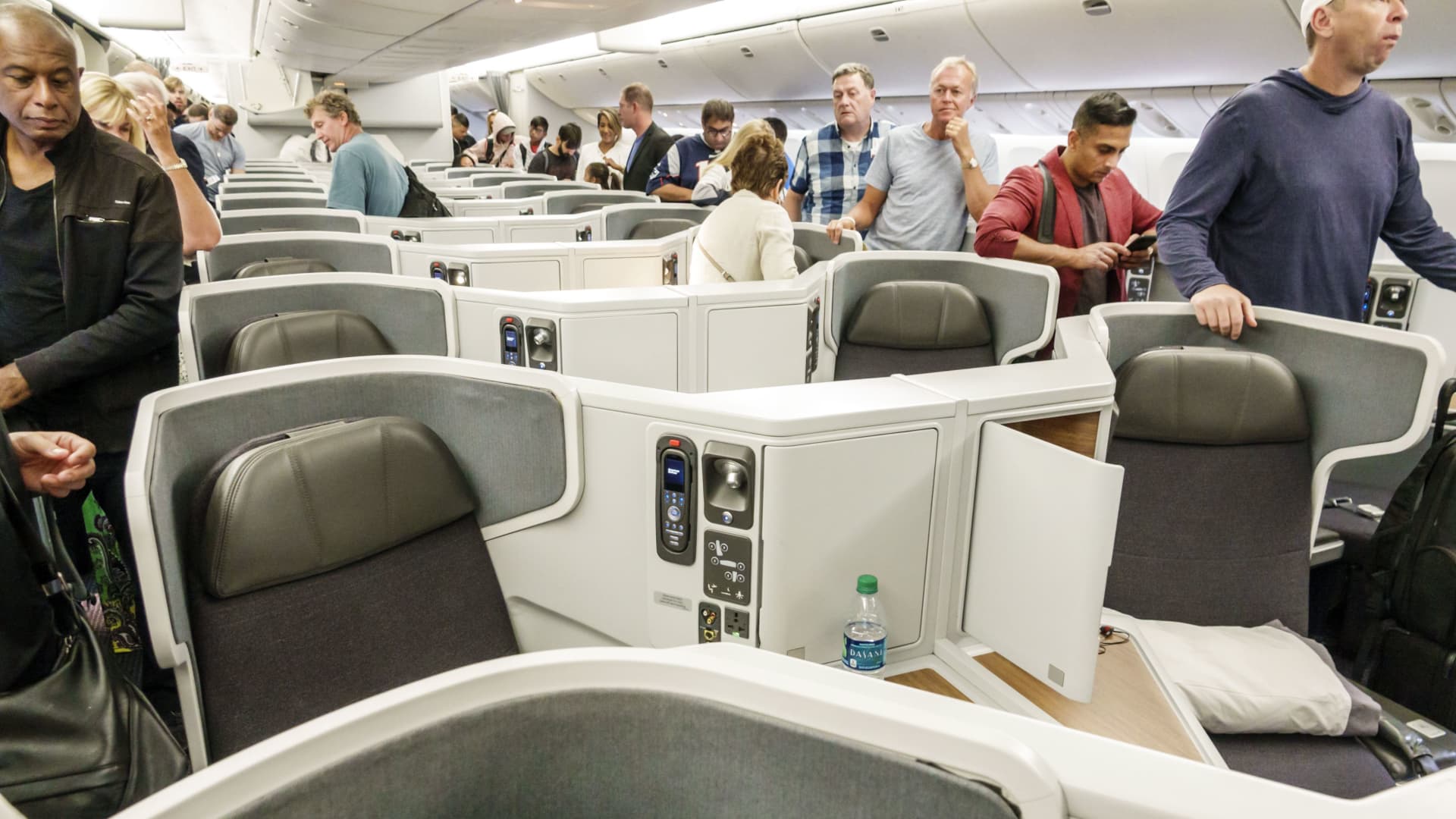
Passengers deplane through the business class seating area on an American Airlines flight, London Heathrow Airport, Aug. 14, 2018.
Jeff Greenberg | Universal Images Group | Getty Images
Cheap seats aren’t enough for airline passengers anymore. Since the pandemic, travelers have shown airlines that they’re willing to pay up to sit at the relatively spacious front of the cabin. That means that many of the seats are already full, so it’s harder for frequent flyers to score free upgrades to the front of the airplane.
And the ranks of frequent flyers with elite status are swelling all the way from the airport lounge to the packed first boarding group, meaning more competition for those seats. Expect even more crowds during the year-end holiday period, which airlines predict will set another record.
Even in the off-season in early 2025, executives have been forecasting strong demand. U.S. airlines’ capacity in the first quarter will be up about 1% from a year earlier, according to aviation data firm Cirium.
"We’re seeing probably our best unit revenues on the transatlantic [routes], for example, in the dead of winter," said Delta Air Lines President Glen Hauenstein at an investor day in November.
The price difference between first class and coach varies, of course, based on distance, demand, time of year, and even time of day. For example, a round-trip ticket on United Airlines from its hub in Newark, New Jersey, to Los Angeles International Airport during the first week of February was $347 in standard economy and $1,791 in the carrier’s Polaris cabin, which features lie-flat seats, but not access to the international business-class lounge.
American Airlines’ nonstop flight from New York to Paris during Easter week 2025 was $1,104 in coach and $3,038 in the airline’s Flagship Business class.
From Giveaways to Paying Up
About 15 years ago, travelers were paying for seats in just 12% of Delta’s domestic first class. Now, that is closer to 75% and climbing, Hauenstein told investors last month.
"We gave them away based on a frequent flyer system," Hauenstein said about first-class seats in 2010 and earlier. "The incentive was to spend as little as possible, fly as long as possible, and get upgraded as often as possible. That led to a position where our most valued products were the biggest loss leaders."
That’s now reversed for Delta, he said, as more money is going to the front of the cabin. The carrier generates 43% of its revenue from main cabin economy tickets, down from a 60% share in 2010.
The trend is cutting across the industry, from Delta, the most profitable carrier, to discounters such as Frontier Airlines, which is adding roomier first-class seats to the front of its Airbus fleet in 2025. On Wednesday, JetBlue Airways said it would introduce two or three rows of domestic business class on planes that don’t have its highest tier Mint business class with lie-flat seats, dubbing it "junior Mint."
Bigger Business
Airlines are now racing to add first-class sections or bigger international business classes featuring bigger screens and closing doors to the flatbed seats.
"We’ve seen more paid demand for premium cabin than we ever did pre-pandemic," said Scott Chandler, vice president of revenue management at American Airlines. "More people want the experience of the premium cabin."
Chandler said American has worked over the past few years to make it easier for customers to buy up to pricier cabins, with post-purchase options to upgrade to first class or other cabins such as premium economy.
Conclusion
The shift away from free upgrades and towards paid premium seats is a significant change in the airline industry. As passengers become more willing to pay for premium services, airlines are adapting by offering more premium products and increasing revenue. This trend is likely to continue, with airlines competing to offer the best premium experiences to attract high-paying customers.
FAQs
Q: Why are airlines charging more for premium seats?
A: Airlines are charging more for premium seats because there is a high demand for these seats, and passengers are willing to pay for the extra amenities and services.
Q: What are some of the premium amenities offered by airlines?
A: Premium amenities can include lie-flat seats, priority check-in and boarding, access to airport lounges, and upgraded food and beverages.
Q: Can I still get free upgrades to first class?
A: In the past, it was possible to get free upgrades to first class through airline loyalty programs. However, with the shift towards paid premium seats, free upgrades are becoming less common.


Community Mentorship Programs Help Strengthen Local Workforce and Social Impact

Low-Code Platforms are Changing How Businesses Build Internal Technology

Microlearning in Employee Training: A Practical Approach to Workplace Skill Development

Decision-Making Frameworks Improve Strategic Leadership and Organizational Clarity

Career Ladder Programs Strengthen Workforce Development and Employee Retention

Workplace Recognition Programs Improve Organizational Culture and Employee Engagement

Why Mental Endurance is Essential for Workplace Resilience

What Informational Interviews are and Why they Matter

How Emotional Intelligence Can Help You Manage Stress and Build Resilience

Interview with Dr. Kristy K. Taylor, WORxK Global News Magazine Founder

Sarah Herrlinger Talks AirPods Pro Hearing Aid

NetWork Your Way to Success: Top Tips for Maximizing Your Professional Network

Unlocking Human Potential: Kim Groshek’s Journey to Transforming Leadership and Stress Resilience

The Power of Belonging: Why Feeling Accepted Matters in the Workplace

Health-care stocks fall after Warren PBM bill, Brian Thompson shooting

Glenda Benevides: Creating Global Impact Through Music
-
 Resiliency7 months ago
How Emotional Intelligence Can Help You Manage Stress and Build Resilience
-
 Career Advice1 year ago
Interview with Dr. Kristy K. Taylor, WORxK Global News Magazine Founder
-
 Diversity and Inclusion (DEIA)1 year ago
Sarah Herrlinger Talks AirPods Pro Hearing Aid
-
 Career Advice1 year ago
NetWork Your Way to Success: Top Tips for Maximizing Your Professional Network
-
 Changemaker Interviews1 year ago
Unlocking Human Potential: Kim Groshek’s Journey to Transforming Leadership and Stress Resilience
-
 Diversity and Inclusion (DEIA)1 year ago
The Power of Belonging: Why Feeling Accepted Matters in the Workplace
-
 Global Trends and Politics1 year ago
Health-care stocks fall after Warren PBM bill, Brian Thompson shooting
-
 Changemaker Interviews12 months ago
Glenda Benevides: Creating Global Impact Through Music