
Global Trends and Politics
Trump urges Congress to enact 10% credit card interest rate cap

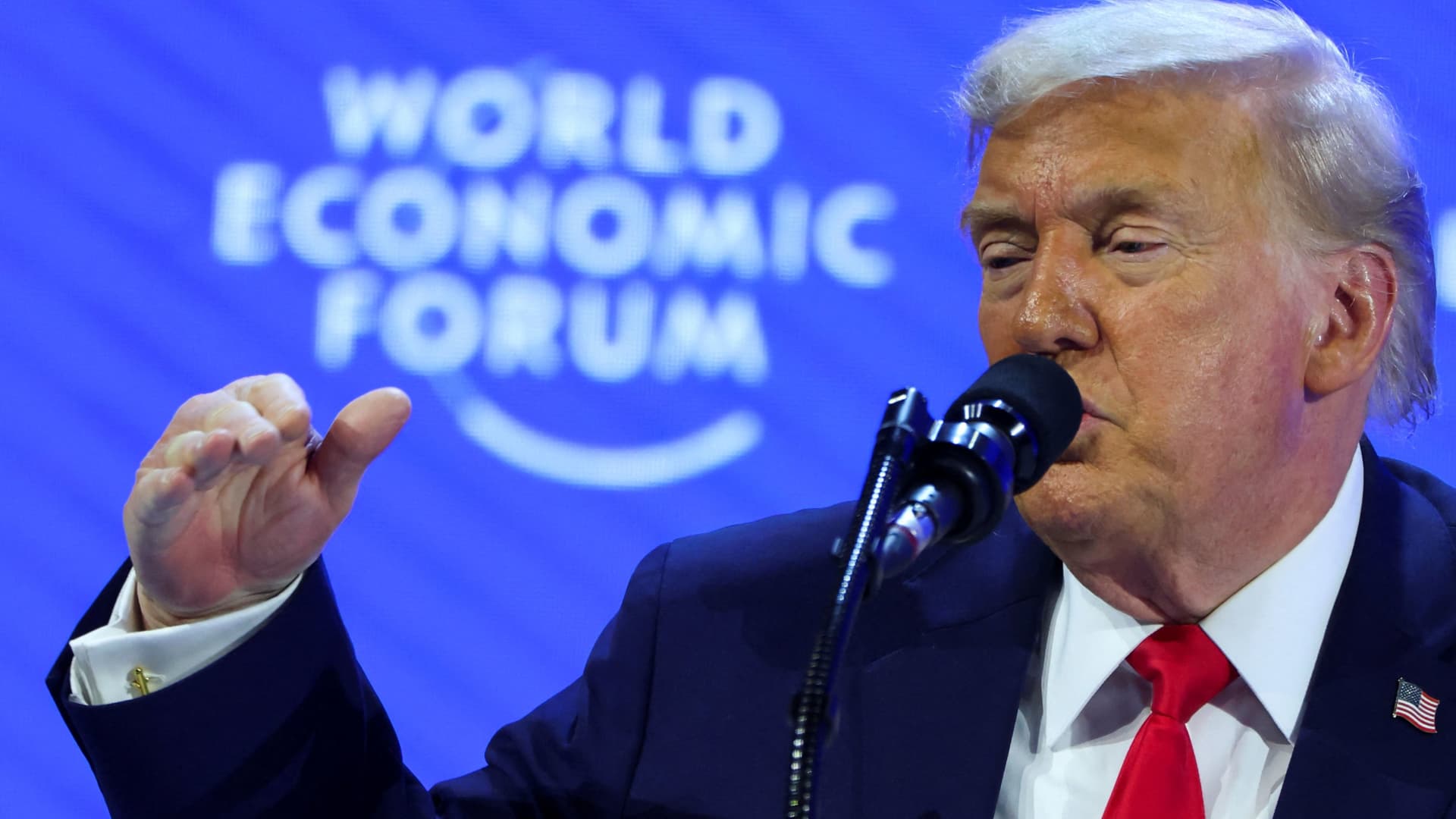
President Trump Calls for Credit Card Rate Cap
President Donald Trump recently urged lawmakers to pass legislation that would limit credit card interest rates to 10%. This move comes after his social media post earlier this month, in which he encouraged banks to voluntarily lower their rates. Speaking at the World Economic Forum in Davos, Switzerland, Trump emphasized the need for this cap, stating that it would help millions of Americans save for a home.
Trump’s comments highlighted the exorbitant interest rates charged by some banks, with rates as high as 28%, 30%, 31%, and 32%. He questioned the legitimacy of such rates, asking, “Whatever happened to usury?” The president’s remarks were met with a positive response from the banking sector, with shares of banks climbing after his comments. The KBW Bank Index rose 2.2% in morning trading, while Capital One, which relies heavily on credit cards for revenue, advanced 1.9%.
Legislative Path and Industry Response
The Trump administration’s decision to pursue a legislative path to cap credit card rates may be the least threatening approach for the industry. A bill introduced by Sens. Josh Hawley and Bernie Sanders last year, which proposed a 10% cap on card APRs for five years, has stalled in Congress. Analysts, including Sanjay Sakhrani of KBW, believe that the likelihood of a card bill gaining enough bipartisan support to become law is low. Republican lawmakers, including House Speaker Mike Johnson, have expressed caution regarding card price controls.
Despite the uncertainty surrounding the proposal’s chances of passing, Trump’s influence among GOP lawmakers could potentially improve its prospects. However, it is unclear whether the president’s pressure will be enough to sway lawmakers. The episode may demonstrate the limits of Trump’s ability to persuade the financial industry to voluntarily give up billions of dollars in revenue to support his election-year affordability push.
Industry Concerns and Counterarguments
After Trump’s initial social media post, banks expressed concerns that a rate cap would have unintended consequences, such as lenders canceling accounts for many card customers, particularly those with lower credit scores. The president claimed that lenders who didn’t comply with the rate cap would be “in violation of the law,” but bankers countered that they were already compliant with existing laws. Privately, bankers and their lobbyists hope to fend off the president’s request, given the difficulty of passing legislation.
JPMorgan Chase CEO Jamie Dimon suggested that the U.S. government should test the rate cap in two states, Vermont and Massachusetts, to demonstrate the potential consequences of price controls. Dimon argued that such a move would be an “economic disaster,” leading to a drastic reduction in the credit card business for 80% of Americans.


Portable Benefits Could Fix the Gig Economy’s Biggest Problem

Ethical Reasoning Has Become a Core Workplace Skill and Training Programs Are Missing It

Stakeholder Pressure on CEOs Has Reached a Breaking Point

Identity Resilience at Work and Why It Matters More Than Grit

The Revenge of Middle Management and Why Organizations Should Pay Attention

First-Generation Professionals Face a Different Workplace and Nobody Prepares Them for It

Small Business Survival in Underserved Communities Needs More Than Microloans

Aging Populations are Reshaping Labor Markets Faster Than Policy Can Respond

How Emotional Intelligence Can Help You Manage Stress and Build Resilience

Interview with Dr. Kristy K. Taylor, WORxK Global News Magazine Founder

Sarah Herrlinger Talks AirPods Pro Hearing Aid

Unlocking Human Potential: Kim Groshek’s Journey to Transforming Leadership and Stress Resilience

NetWork Your Way to Success: Top Tips for Maximizing Your Professional Network

The Power of Belonging: Why Feeling Accepted Matters in the Workplace

Health-care stocks fall after Warren PBM bill, Brian Thompson shooting

Glenda Benevides: Creating Global Impact Through Music
-
 Resiliency1 year ago
How Emotional Intelligence Can Help You Manage Stress and Build Resilience
-
 Career Advice2 years ago
Interview with Dr. Kristy K. Taylor, WORxK Global News Magazine Founder
-
 Diversity and Inclusion (DEIA)2 years ago
Sarah Herrlinger Talks AirPods Pro Hearing Aid
-
 Changemaker Interviews2 years ago
Unlocking Human Potential: Kim Groshek’s Journey to Transforming Leadership and Stress Resilience
-
 Career Advice2 years ago
NetWork Your Way to Success: Top Tips for Maximizing Your Professional Network
-
 Diversity and Inclusion (DEIA)2 years ago
The Power of Belonging: Why Feeling Accepted Matters in the Workplace
-
 Global Trends and Politics2 years ago
Health-care stocks fall after Warren PBM bill, Brian Thompson shooting
-
 Changemaker Interviews2 years ago
Glenda Benevides: Creating Global Impact Through Music