
Strategic Leadership
Operational Red Teaming: Strengthening Strategic Decisions Through Internal Challenge

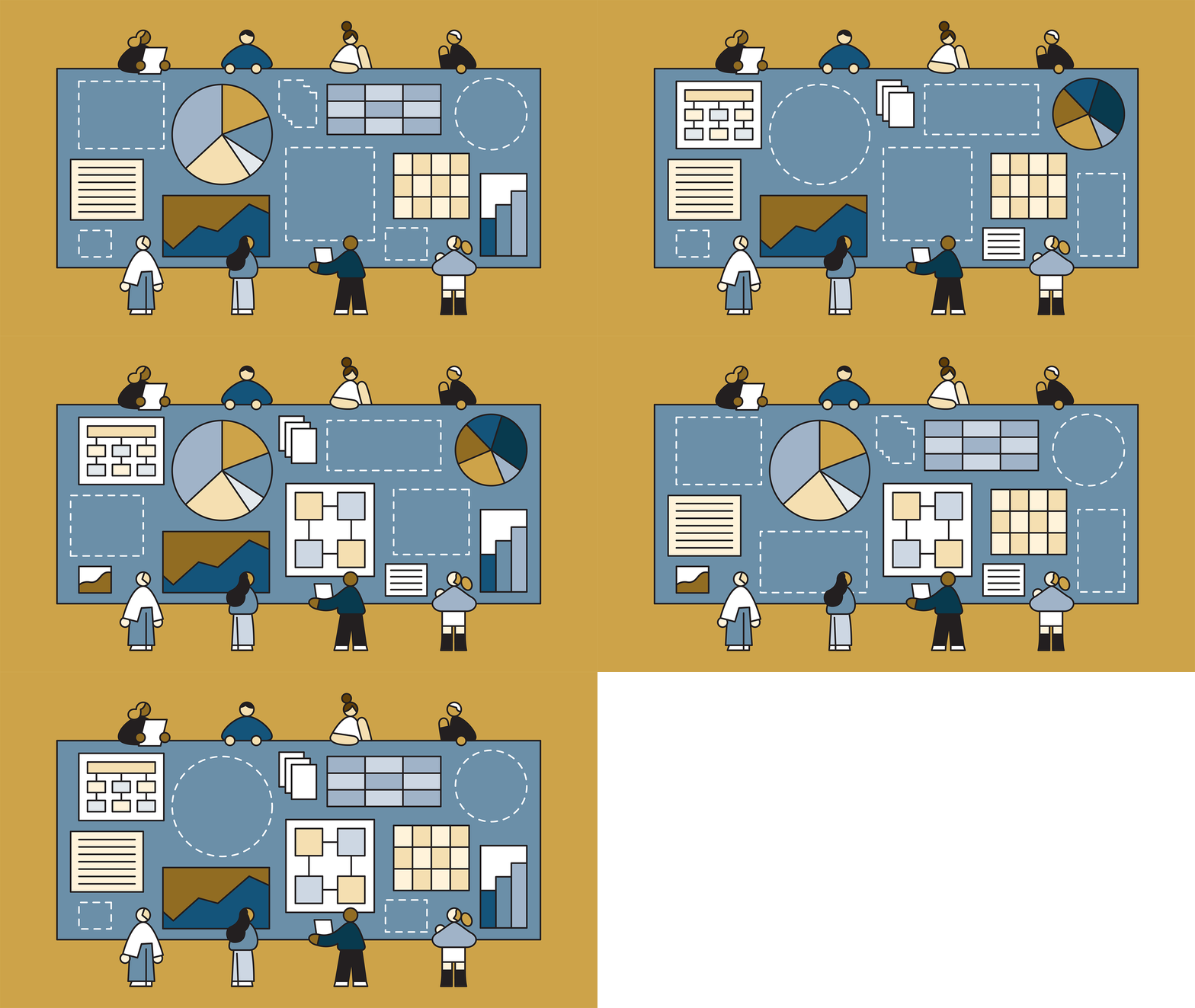
Strategic leadership is currently shifting toward the adoption of “Red Teaming”—a structured method where a designated internal group deliberately challenges an organization’s plans, assumptions, and security protocols. Rather than relying on traditional consensus-based decision-making, which can often lead to groupthink, leaders are institutionalizing dissent to identify hidden vulnerabilities before they manifest as operational failures. This proactive friction ensures that a strategy is not merely a reflection of executive preference but a battle-tested roadmap capable of withstanding the complexities of the modern market.
Moving Beyond Consensus in Executive Deliberation
The standard boardroom environment often prioritizes alignment and harmony. While these are valuable for execution, they can be detrimental during the planning phase. When a leadership team is too quick to agree on a direction, they risk overlooking technical flaws or shifting market variables. This “blind spot” is frequently where large-scale projects fail—not for lack of resources, but for lack of critical scrutiny.
Operational Red Teaming addresses this by legitimizing the role of the “adversary.” In a Red Team session, a group of experienced staff members is tasked with dismantling a proposed strategy. They look for logical inconsistencies, over-optimistic timelines, and technical dependencies that have not been fully vetted. By treating this challenge as a formal requirement rather than a personal critique, leaders can extract the most rigorous version of a plan.
The Mechanics of the Strategic Stress Test
An effective Red Teaming exercise is a disciplined process that moves through specific phases of deconstruction. It requires a clear separation between the “Blue Team” (the planners) and the “Red Team” (the challengers).
The process typically begins with Assumption Mapping, where the Red Team identifies every underlying belief the strategy relies upon—such as the stability of a specific supply chain or the rapid adoption of a new software tool. Once these are mapped, the team performs a Pre-Mortem, a technical exercise where they imagine the project has already failed and work backward to determine the most likely causes. This shift in perspective allows leaders to identify high-risk areas that are often masked by the enthusiasm of a new launch.
Following the pre-mortem, the Red Team presents a Vulnerability Report. This is not a list of reasons to stop a project, but a diagnostic tool used to strengthen it. It provides the leadership team with a “menu of fixes” to address before the strategy is finalized and resources are committed.
Professional Resiliency and the “Constructive Dissenter” Skill
For those currently navigating a career pivot or a job search, the ability to perform or lead a Red Team exercise is a high-value competency. In interviews, candidates often focus on their ability to build and agree. However, demonstrating the ability to provide “Structured Dissent”—to identify risks and propose technical mitigations—positions a candidate as a strategic thinker rather than just a task executor.
A professional who can explain how they helped a previous employer avoid a costly error by stress-testing a proposal shows a level of maturity that is rare. It proves they possess “Technical Skepticism,” a trait that protects an organization’s capital and reputation. For a job seeker, reframing a “difficult” trait like being overly analytical into the “Red Teaming” skill set transforms a personality quirk into a formal leadership asset.
Institutionalizing the “Safe-to-Fail” Dialogue
To be successful, Red Teaming requires a culture of psychological safety. If employees fear that challenging a senior leader’s idea will lead to professional repercussions, the exercise will be superficial and ineffective. Strategic leaders must actively signal that the “Red Team” is a prestigious and necessary function.
This is often achieved by rotating different team members into the Red Team role. This practice not only provides fresh perspectives on every project but also trains the entire workforce in the art of critical analysis. When every department—from engineering to finance—understands how to stress-test their own work, the organization develops a decentralized form of resilience. It creates a workforce that is inherently diagnostic, identifying and fixing errors at the source rather than waiting for an executive review.
Strengthening the Final Strategic Output
The ultimate goal of Red Teaming is not to create a culture of negativity, but to produce a strategy of superior quality. A plan that has survived a rigorous internal challenge is more likely to succeed in a live environment. It allows the leadership team to move forward with a level of confidence that is based on evidence rather than ego.
By integrating this level of rigor into the decision-making process, organizations ensure that their strategic output is as resilient as their technical infrastructure. In an era where the cost of a failed strategy can be catastrophic, the “internal adversary” is perhaps a leader’s most important ally.


Portable Benefits Could Fix the Gig Economy’s Biggest Problem

Ethical Reasoning Has Become a Core Workplace Skill and Training Programs Are Missing It

Stakeholder Pressure on CEOs Has Reached a Breaking Point

Identity Resilience at Work and Why It Matters More Than Grit

The Revenge of Middle Management and Why Organizations Should Pay Attention

First-Generation Professionals Face a Different Workplace and Nobody Prepares Them for It

Small Business Survival in Underserved Communities Needs More Than Microloans

Aging Populations are Reshaping Labor Markets Faster Than Policy Can Respond

How Emotional Intelligence Can Help You Manage Stress and Build Resilience

Interview with Dr. Kristy K. Taylor, WORxK Global News Magazine Founder

Sarah Herrlinger Talks AirPods Pro Hearing Aid

Unlocking Human Potential: Kim Groshek’s Journey to Transforming Leadership and Stress Resilience

NetWork Your Way to Success: Top Tips for Maximizing Your Professional Network

The Power of Belonging: Why Feeling Accepted Matters in the Workplace

Health-care stocks fall after Warren PBM bill, Brian Thompson shooting

Glenda Benevides: Creating Global Impact Through Music
-
 Resiliency1 year ago
How Emotional Intelligence Can Help You Manage Stress and Build Resilience
-
 Career Advice2 years ago
Interview with Dr. Kristy K. Taylor, WORxK Global News Magazine Founder
-
 Diversity and Inclusion (DEIA)2 years ago
Sarah Herrlinger Talks AirPods Pro Hearing Aid
-
 Changemaker Interviews2 years ago
Unlocking Human Potential: Kim Groshek’s Journey to Transforming Leadership and Stress Resilience
-
 Career Advice2 years ago
NetWork Your Way to Success: Top Tips for Maximizing Your Professional Network
-
 Diversity and Inclusion (DEIA)2 years ago
The Power of Belonging: Why Feeling Accepted Matters in the Workplace
-
 Global Trends and Politics2 years ago
Health-care stocks fall after Warren PBM bill, Brian Thompson shooting
-
 Changemaker Interviews2 years ago
Glenda Benevides: Creating Global Impact Through Music